 From here you can access the issues regarding:
Testing – Training that we were involved in.
For European Issues – consultations – campaigns – Click Here
We also monitored motorcycle issues and were involved at Government Departmental level and lobbying in the background, setting the ground work, for the future.

 Last year (March 2014) we reported on the trials to introduce a roller brake test for motorcycles going through their MoT inspection at the Northern Irelands test – MoT – Centres.
This change was introduced on 6th October 2014 – while there are still concerns from riders on the rolling brake test, Lord Morrow (Maurice) of Clogher Valley – DUP (Democratic Unionist Party), MLA from Fermanagh and South Tyrone has asked a raft of questions and received answers in the Northern Ireland Assembly.
The questions cover every aspect of the introduction and operation of the motorcycle roller brake test as operated at the MoT Test Centres in Northern Ireland.

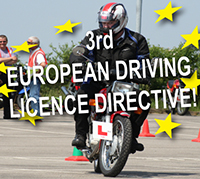 The European Directive (3rd European Driving Licence Directive) was implemented across Europe on the 19th January 2013, including Northern Ireland.
The directive included a raft of changes to the motorcycle licence and testing requirements.
At Right To Ride we reported extensively on the implementation and were involved in replying to a public consultation and a stakeholder’s group with riders group, trainers and government agencies.

 Twenty years after Compulsory Basic Training (CBT ) was introduced in the rest of the United Kingdom, the Driver & Vehicle Agency (DVA) will be introducing a system of CBT in Northern Ireland to be completed by those wishing to ride a motorcycle as a learner rider on public roads.
In addition an Approved Motorcycle Instructor (AMI) Register, similar to that of the present Approved Driving Instructor (ADI) Register, will be introduced in order to regulate this training. Both the Approved Motorcycle Register and Compulsory Basic Training are planned to be introduced by December 2010.
CBT was finally introduced in February 2012.

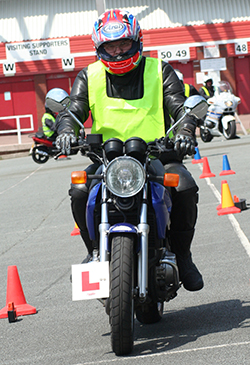 Monday 27th June 2011 saw a change not only to the practical riding test for learner motorcyclists but also for the practical driving test for car, large goods vehicle (LGV), passenger carrying vehicle (PCV) tests and the approved driving instructor (ADI) driving ability (sometimes called ‘part two’).
The idea behind “Independent Driving” is to help make the driving test more representative of real driving to allow test candidates to demonstrate their ability to drive safely in realistic driving situations, rather than memorising a particular test route. The Driver & Vehicle Agency (DVA) will no longer publish details of test routes.

 The motorcycle test to gain a motorcycle licence or to ride a motorcycle – scooter – moped on Northern Ireland roads has seen major changes in recent months and will see further changes within the next couple of years.
These changes include the introduction of CBT (Compulsory Basic Training) and an Approved Motorcycle Instructor (AMI) Register in February this year, the recent introduction of “Independent Driving” in the motorcycle practical riding test, the introduction of “European” based motorcycle test in 2008 and the upcoming implementation in 2012 of a 3rd European Driving Licence Directive.

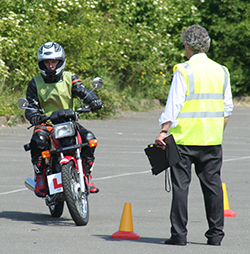 The Minister for Road Safety Mike Penning from the Department for Transport (DfT) in Great Britain has stated that the DfT intends to review the two part motorcycle test and to trial a new, single, on-road motorcycle test.
The announced motorcycle test review and subsequent report is the result of work the Department has undertaken with motorcycle groups, training organisations and others since June 2010. This is on the back of another report by the Parliamentary Transport Select Committee (TSC) which was the result of a short enquiry which took place in October 2009 in the House of Commons.
This “European” test was introduced in Northern Ireland in December 2008 and in April 2009 in the rest of the UK . Its aim was to improve road safety.

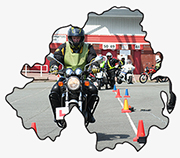 Motorcycle organisations in the UK including the Motorcycle Industry, have responded to a report by the Parliamentary Transport Select Committee (TSC) on the new European motorcycle test. The report is the result of a short enquiry with submitted written evidence and an oral evidence session which took place in October 2009 in the House of Commons.
The “new” European test was introduced in Northern Ireland in December 2008 and in April 2009 in the rest of the UK . Its aim is to improve road safety. The test employs two practical elements: one consists of technical exercises off-road, designed to assess the rider’s ability to control the machine safely (including a swerve and brake manoeuvre). These are tested at designated Multi Purpose Test Centres (MPTCs). The other element is a road-based test of traffic handling skills on the public highway.

Speak Your Mind